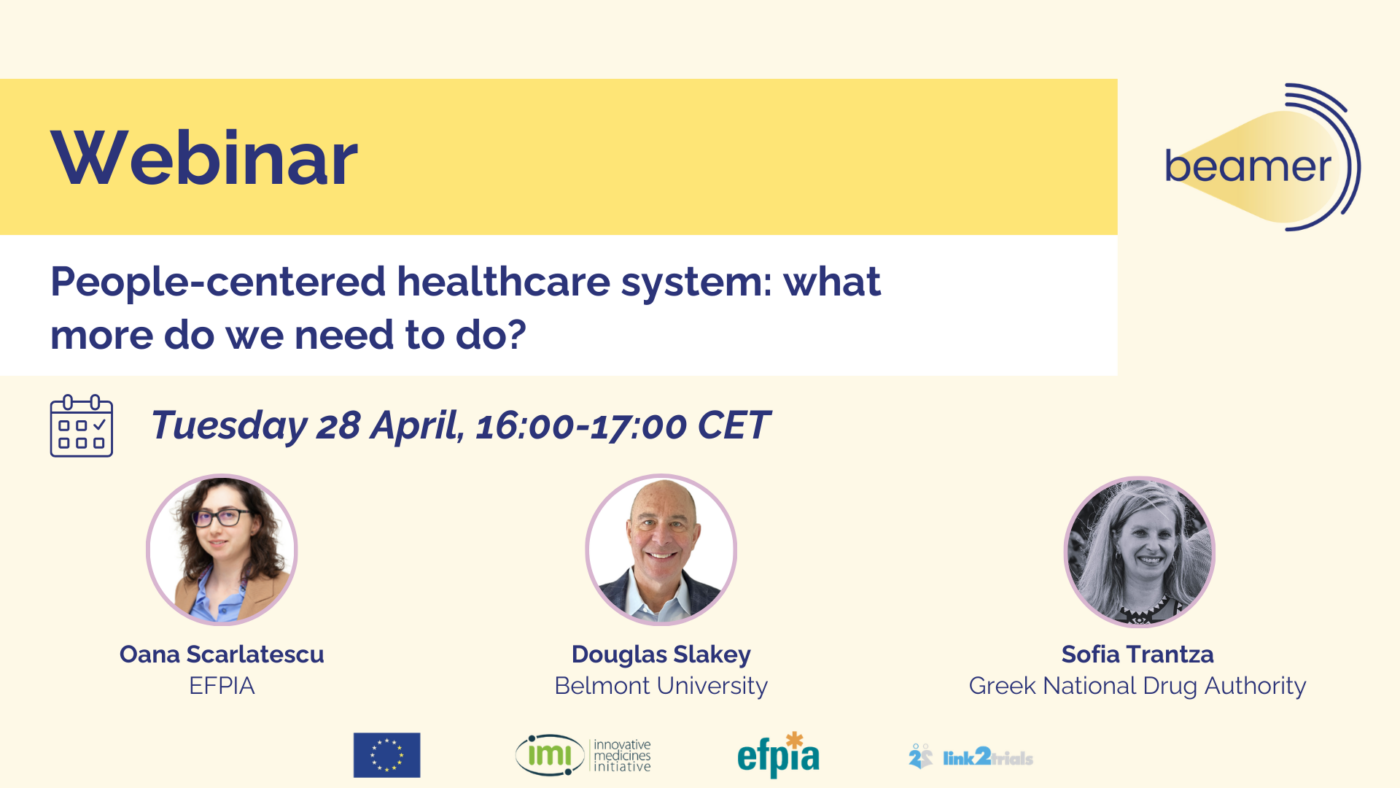
Register now for the next webinar titled People-centered healthcare system: what more do we need to do?, on Tuesday 28 April 2026 at 16:00-17:00 CET.
Studies estimate that approximately 50% of medications are not taken according to prescribed instructions, often because people do not fully understand how or why a treatment works. Treatment adherence therefore reflects more than individual behaviour: it also highlights gaps in how healthcare systems communicate with and support patients.
Building a more people-centred healthcare system means ensuring that information is understandable, relevant, and adapted to each individual. By tailoring communication to patients’ needs and levels of health literacy, healthcare providers can help people to better engage with their treatments.
The BEAMER project contributes to this shift through the development of B-COMPASS, a questionnaire designed to help clinicians personalize the way treatment information is delivered, ultimately improving adherence and health outcomes across Europe.
We will have the pleasure of welcoming three panelists to discuss this important issue.
- Oana Scarlatescu, Director Strategic partnerships, healthcare systems, EFPIA, Belgium
Oana Scarlatescu is Director of Strategic Partnerships & Health Systems at EFPIA, where she leads patient engagement and partnerships with stakeholders across the health sector. She previously worked in global health and development in Geneva and holds degrees in international relations and communications.
- Douglas Slakey, Chair of the Health Systems Innovation collaborative, Belmont University, USA
Dr. Douglas Slakey is an internationally recognized transplant surgeon, healthcare leader, and administrator dedicated to improving healthcare systems and patient outcomes. He is the best-selling author of The Process Manifesto: Improving Healthcare in a Complex World. He currently serves as Professor and Chair of Health Systems Science at Belmont University’s Frist College of Medicine, where he founded the Belmont Collaborative for Health Systems Innovation, a global hub focused on advancing research and scalable solutions to improve healthcare delivery and value across the whole-person health journey. He is also the inaugural holder of the HCA Healthcare Endowed Chair for Health Systems Science and a founder of LifePathEI, an advanced platform supporting individuals in their wellbeing journey. Previously, Dr. Slakey spent five years at Advocate Aurora Health as Chief of Surgical Services, guiding strategy and innovation across 27 hospitals. Prior to that, he served for 21 years at Tulane University, where he became Professor and Chair of Surgery and led the transplant program, pioneering advances in immunosuppression and minimally invasive surgery while improving access to care in the Gulf South.
Dr. Slakey has authored more than 150 peer-reviewed publications and numerous abstracts, serves on several medical journal editorial boards, and holds degrees from UC Berkeley (BA, MPH) and the Medical College of Wisconsin (MD), with further training at the University of Oxford and Johns Hopkins.
- Sofia Trantza, Assessor of the Evaluation Division, Medicinal products, Greek National Drug Authority, Greece
Sofia Trantza is a pharmacist, specialisedd in Pharmaceutical Technology and Pharmacovigilance and certified in the field of Medical Affairs. She recently completed her studies (CAS) in the field of Radiopharmaceuticals at the ETH University of Zurich, Switzerland. She holds a certification for the Safety of Cosmetics from the University of VUB in Belgium. She has over 7 years of experience as a Person Responsible for Pharmacovigilance (QPPV) in the Pharmaceutical Industry and is simultaneously certified according to ISO 9001: 2008, 2015 and ISO 13485. She joined the National Medicines Organization (EOF) in 2016, served as an employee in the Adverse Reactions Department and as an alternate member of the European Pharmacovigilance Committee (PRAC) for Greece. She held the position of PRAC member, representing Greece at the European Medicines Agency (EMA), until December 2024, is an Assessor in the Department for the Evaluation of Medicinal Products for Human Use and is a pharmacist in the Cosmetics Department and in the Standing European Committee on Cosmetics and the relevant working groups. Recently she has been accepted in the MSc of Software Engineering and will study Artificial Intelligence in the University of Quantic, USA.